General · September 9, 2026
Plume Introduces FACTOR, A Book of Working Capital Finance Onchain
Today, we are opening FACTOR, a limited-capacity vault on Plume Vaults.

Today, we are opening FACTOR, a limited-capacity vault on Plume Vaults.
Created in partnership with Tradeable and Deep Ocean Partners, FACTOR offers a unique onchain asset experience. Most tokenized credit is a single fund wrapped in a token. FACTOR works differently. It is a curated, actively managed book of invoice factoring and working capital facilities, underwritten in partnership with a quantitative credit fund, with liquidity mechanics that only work because the underlying asset is short.
Users will deposit stablecoins, receive the FACTOR receipt token, and hold economic exposure to a portfolio of net working capital facilities: invoice factoring, uncommitted revolvers, and other short-dated, self-liquidating, asset-backed credit.
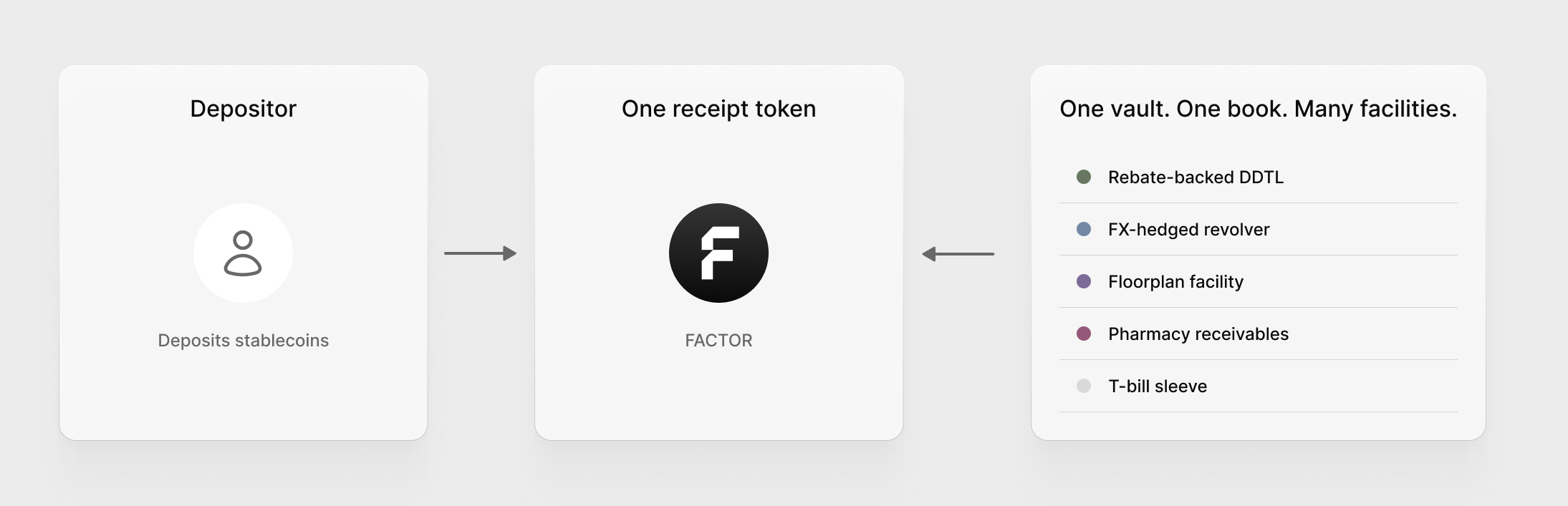
The initial launch is targeting an attractive set of inaugural facilities, offering 14%+ net APY, weekly liquidity, and senior secured exposure with investment-grade obligors behind most of the collateral.
Take a deep dive into how FACTOR is constructed.
What Is Net Working Capital Financing?
Net Working capital financing provides businesses with short-term funding to cover everyday operating expenses, such as inventory, payroll, and supplier payments, while they wait for revenue or receivables to be collected.
For example, a supplier ships goods to a large customer and invoices them. The time between invoicing and payment can be considerable, even up to 120 days. In the meantime, the supplier has to keep up business expenses such as payroll or a purchase order.
Working Capital Financing, of which invoice factoring is a subset, fills this gap. A financier buys or lends against the invoice at a discount. They then send the supplier cash immediately and collect from the customer when the invoice is due. The financier keeps the spread between what is advanced and what is collected.
There are three unique traits to this type of financing:
- Short duration, self-liquidating. Invoices pay in weeks, not years. The collateral liquidates itself on a schedule written into the invoice.
- It is backed by the customer's credit, not the supplier's. The supplier might be a five-year-old company doing $25 million of revenue. The obligor writing the check is often a utility, a Fortune 500 buyer, or a global marketplace. That’s who pays back the invoice collateral.
- It is cash controlled. Payments are directed to a lender-controlled account. The financier does not wait to be paid; the cash lands with it first.
Net working capital (NWC) financing is an umbrella term for a range of short-term financing structures, including factoring, purchase-order finance, receivables-backed revolvers, and rebate-backed delayed-draw loans. The structures differ, but the underlying purpose is the same: financing a business’s working capital needs. FACTOR brings these different forms of working capital financing together in a single diversified portfolio, helping businesses turn current assets into cash.
Why This Market Is Underserved
The US factoring market is roughly $170 billion a year, and it is remarkably fragmented. The problem is that the market is built for extremes. The biggest providers focus on very large companies, while hundreds of smaller factors serve businesses looking for less than $1 million at a time. That leaves a meaningful gap for companies looking for $2 million to $20 million in working capital.
Banks generally do not want to deal with these loans because each one requires a lot of hands-on work relative to its size. Fintech lenders can move faster, but don’t have the credit expertise and often prioritize generating lots of loans over the deep, relationship-driven underwriting these businesses require. And traditional private credit funds are increasingly focused on much larger investments.
The result is a large, recurring market where good businesses can struggle to get the financing they need simply because their funding needs fall between the cracks. It is in this gap where the opportunity lies.
This is also why bringing the market onchain is about more than putting loans on a blockchain. The hard part is finding, underwriting, monitoring, and servicing hundreds of real businesses. FACTOR is built around that underlying infrastructure first (built by decades of experience from Deep Ocean Partners), with tokenization making the resulting portfolio accessible onchain.
Where the Yield Actually Comes From
A common assumption in crypto is that higher yield means taking more risk. Working capital financing works differently. The yield comes from how quickly the money gets paid back and put to work again, rather than from taking on more risk with each individual deal.
Take a 30-day invoice. A financier might give a business 98.75% of the invoice upfront, effectively charging 1.25% for providing the cash early. When the customer pays the full invoice 30 days later, the financier receives the full amount and earns the 1.25% difference.
On a single transaction, that is a relatively small return for a short-term advance backed by an invoice that is expected to be paid by a strong business.
But the money does not have to sit still. Once that invoice is paid, the same dollar can immediately be used to finance another invoice, and then another. If it turns over roughly 12 times a year and earns 1.25% each time, that same dollar can generate roughly 15% in gross annual returns.
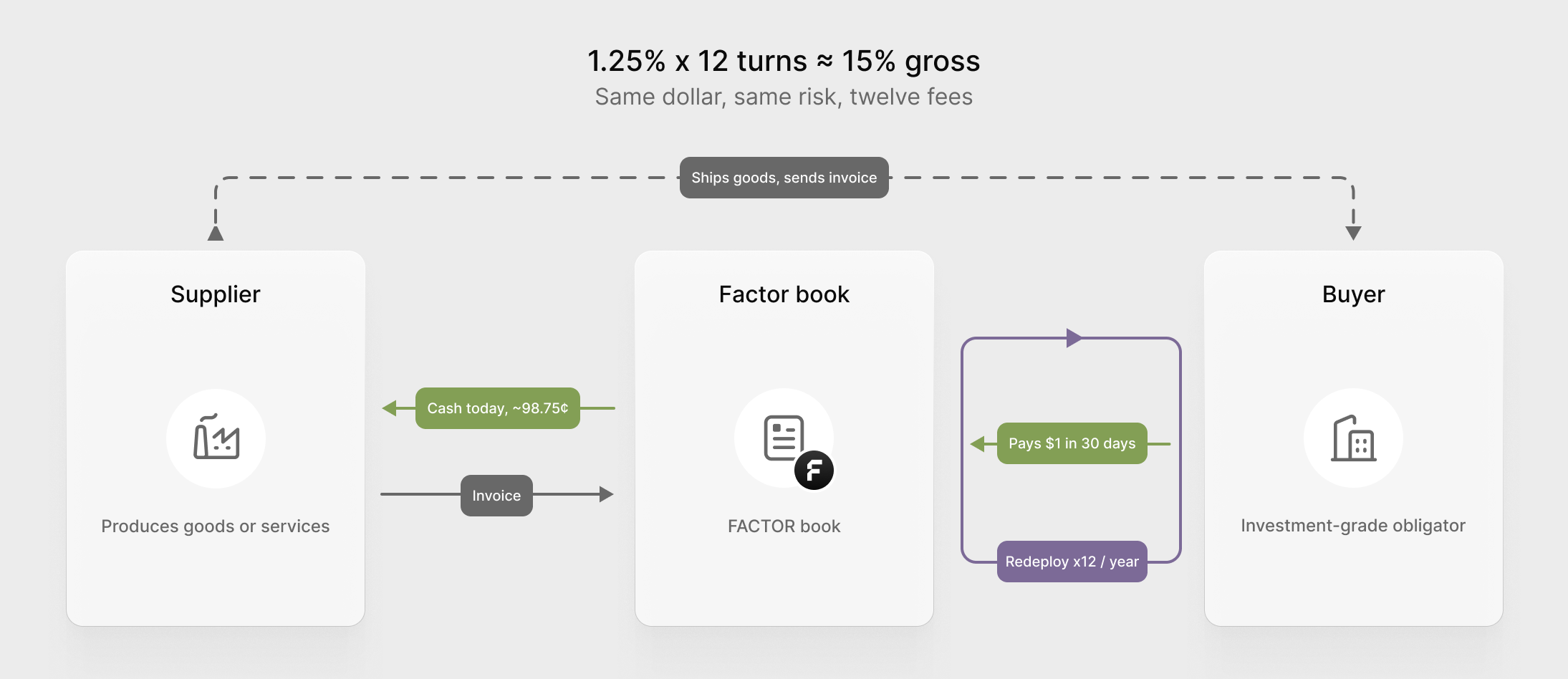
A term loan typically pays interest over the life of one loan. A factoring dollar earns its fee every time it comes back. Across the launch book, the money can be put to work roughly four to twelve times a year, depending on the facility. Each time, the dollar is re-underwritten, against fresh collateral with aging limits and advance rates enforced on every cycle.
This repeated cycle is what drives the annualized yield, and high APYs can be achieved without taking on riskier loans.
Actively Curated, Co-Invested
FACTOR is not a passive wrapper around someone else's fund. Each facility is evaluated deal by deal alongside Deep Ocean Partners (DOP), a New York-based diversified credit fund. FACTOR receipt token issuer holds its position through contractual sub-participations in facilities DOP originates and holds as lender of record. In simple terms, we are invested in the same loans, on the same terms, at the same time.
Before a facility is eligible, it has to meet a set of minimum protections per FACTOR’s own investment policies. These include a separate borrower entity that keeps the assets isolated, first-priority claims on the collateral, and an agreement that directs payments from the underlying businesses into a lender-controlled account. Concentration limits, advance rates (LTVs), eligible collateral criteria, and aging tests are set per facility and monitored continuously.
The launch book holds four facilities across four distinct receivable types once ramped:
- A rebate-backed delayed-draw facility where the obligor is a state utility program
- An FX-hedged receivables revolver where the obligors are global marketplaces
- A floorplan facility against titled inventory with a sub-60-day turn
- A pharmacy receivables line ramping into a major online pharmacy program.
Each facility has different collateral, different underlying customers, and different payment cycles, but they are brought together in a single onchain portfolio represented by one token.
The point of holding a portfolio rather than a single facility is diversification you do not have to build yourself. Especially when it comes to this type of credit, loan structuring, evaluation, and ongoing monitoring is crucial. In a single floorplan financing facility, sophisticated lenders have servicers on hand to diligence each and every vehicle on the lot. And because FACTOR handles the sourcing and underwriting, you do not have to evaluate every individual deal to get the exposure.
Why Nobody Does It This Way
Tokenized private credit today is mostly broken down two ways:
- Fund Token: A share of a large, diversified credit fund. Broad exposure, professional management, and the fund's liquidity terms, which are typically quarterly with notice. Your onchain token is only as liquid as the offchain redemption window.
- Single Facility Token: Exposure to one loan, one borrower, one collateral pool. Transparent, but concentrated, and illiquid until that specific loan pays down.
FACTOR is opening up a third option.
A curated book of short-duration facilities held in one vault, with liquidity engineered at the vault level.
It is uncommon because it requires three things at once:
- A partner originating this niche at scale,
- A participation structure that lets the bankruptcy-remote legal entity behind the vault co-invest rather than buy fund shares
- An asset whose collateral runs off fast enough to make weekly liquidity mechanically real rather than promised.
How Weekly Liquidity Works
Private credit is typically difficult to exit quickly. FACTOR is designed differently: because the underlying financing is short-term and gets repaid regularly, capital can be returned to investors on a weekly basis. Three mechanisms work together to make this possible.
A liquid sleeve. A portion of vault assets sits in short-dated treasuries or similarly liquid assets at all times. This is the first source of money for redemptions, and makes up a portion of the gross-to-net APY differential between FACTOR and the underlying facilities.
Contractual runoff. Invoices pay. Inventory sells. Rebates arrive. Because most facilities are revolving or uncommitted, collected cash can be held back rather than being put back to work when the vault needs liquidity. Due to the regular repayment schedule, the vault can see when the underlying assets are to be repaid weeks in advance. So the vault knows roughly how much cash is coming in before any redemption request is made. This can be contractually called, for no cost, by FACTOR to DOP, for a certain percentage of AUM at any time.
A contractual buyback from the lender of record. This is where FACTOR has an additional layer of liquidity that most tokenized credit products do not. Deep Ocean Partners is obligated to repurchase a portion of FACTOR’s participation interest on request. If the liquid sleeve and incoming collections are depleted, the vault has a contractual counterparty that has already agreed to buy exposure back at current NAV. Liquidity does not depend on finding another buyer in a secondary market. It is built into the underlying agreements.
Together, these are what let FACTOR target a weekly redemption window on an asset class that traditionally locks capital in for months at a time.
.png)
Who Is Deep Ocean Partners?
A product like FACTOR is only as good as the team selecting and managing the underlying investment, so Plume was selective when deciding on a partner. Deep Ocean Partners is a NYC-based, multi-strategy quantitative credit manager focused on short-duration, asset-backed, senior secured lending in the segments of private credit that banks and large funds overlook, the $2.5 million to $50 million check.
What makes DOP different is the combination of technology and credit expertise they bring to these deals. Traditional lenders often rely heavily on financial statements and manual processes, while technology-focused lenders can lack the experience needed to properly assess credit risk. DOP sits in between, using data and technology to make faster, more informed lending decisions without losing the human judgment required to structure and manage the loans.
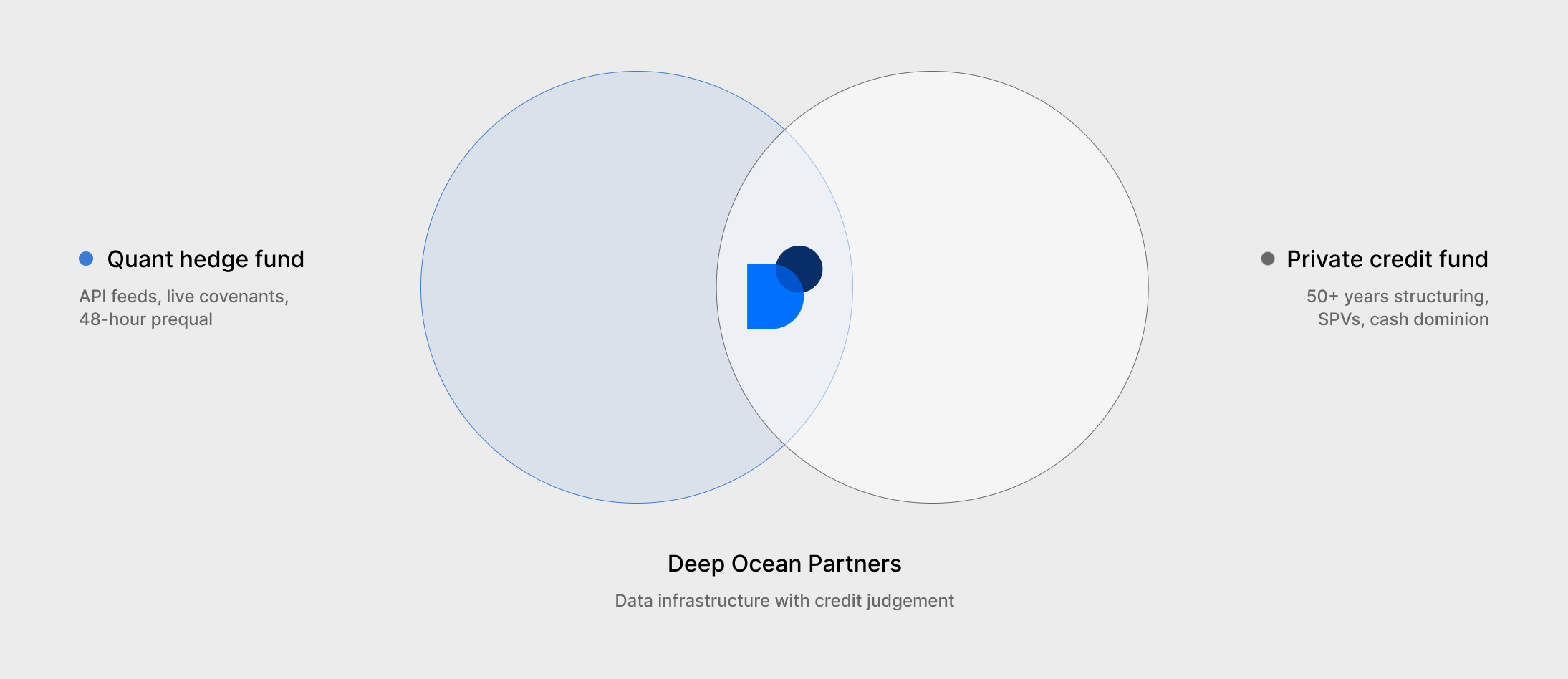
On the technology side, the platform connects directly to systems businesses already use like ERPs, banking, warehouse management, and obligor payment data. Underwriting runs on invoice tapes, aging reports, and obligor credit from multiple bureaus, not just the seller's financial statements, which is what most legacy factors look at. Data on invoices, payment history, inventory, and the businesses that ultimately owe the money can be updated continuously, helping DOP identify changes in a position early. A typical prequalification decision takes around 48 hours.
On the credit side, the team brings 50-plus years of combined underwriting and structuring experience, with alumni of Blackstone, JP Morgan, Point72, and Solus. Their contracts reflect these expertise with inclusions like true-sale SPVs, cash dominion, cross-collateralization, bad-boy guarantees, direct obligor notice. Their target across the firm is 15%+ net, and their working capital sleeve is the strategy FACTOR draws from.
This combination of hedge-fund-grade monitoring and credit-fund-grade structuring is what makes this market scalable. It is why the yield can be high and the risk can be controlled, and it is why we chose to co-invest with them rather than simply distribute their product.
What You Get With FACTOR
With all of this together, and one FACTOR token gives investors exposure to:
- An underserved corner of traditional lending, where mid-sized suppliers pay a premium for capital because banks and large funds have left the market.
- Yield generated by capital efficiency, cycling short-dated advances against investment-grade obligors, rather than by reaching for credit risk.
- A curated, diversified book of facilities, each underwritten deal by deal and co-invested by FACTOR alongside the originator.
- Weekly liquidity, engineered from a liquid sleeve, contractual collateral runoff, and a contractual buyback from the lender of record.
- Top-quartile onchain yield, targeting 14%+ net, with every projection labeled as what it is: a target.
- All of it in partnership with a sophisticated, quantitative credit fund whose infrastructure was built for exactly this asset.
Tokenizing this does not change what an invoice is or who pays it. What changes is that a book of working capital facilities that used to require an LP agreement, a quarterly redemption window, and a seven-figure minimum is now a receipt token in a wallet.
FACTOR is capacity-limited at launch. Explore it live on Plume Vaults now.
Plume Services are not available to U.S. and other Restricted Jurisdiction persons andor residents. Crypto trading involves high risk, including potential loss of all principal. Past performance is not indicative of future results. There are no guarantees of profits, returns, or yields. All APY figures are targets, not guarantees. Information is for educational purposes only—we make no representations or warranties on its accuracy, completeness, suitability, or value. This is not financial advice; consult professionals.

Open finance together
Work with Plume to issue, distribute, and manage real-world assets.